Tuesday, February 9, 2010

Alexander Presents at Conference on Teaching and Learning

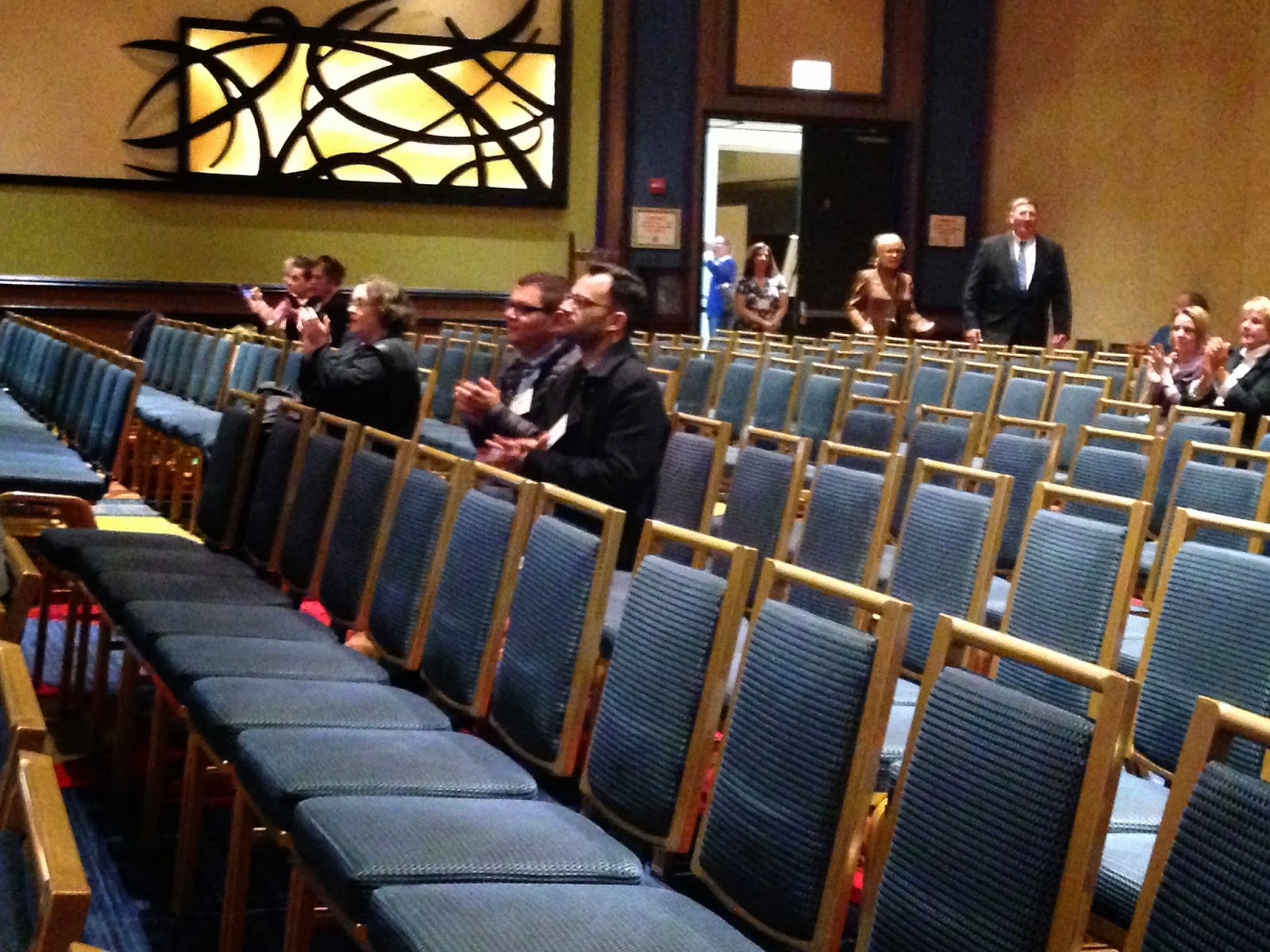
Professor Rob Alexander attended a recent conference in Philadelphia on Teaching and Learning sponsored by American Political Science Association and presented his ideas on how honorary societies such as Pi Sigma Alpha can integrate its efforts with student learning.

Along with Alexander's session, the conference featured speakers such as former U.S. Senator and Governor of Florida Bob Graham and Rogers M. Smith from the University of Pennsylvania. Graham, who now directs the Graham Center for Public Service at the University of Florida, delivered the opening address entitled "Salvaging Citizenship: A Partnership for Pols and Scholars." Professor Smith is the Christopher H. Browne Distinguished Professor and was a former Vice President of the APSA Council. His Keynote Address was entitled "Teaching as Redemption."

Alexander's gave his talk during the Pi Sigma Alpha session on "The Honor Society's Role in Student Education and Professional Development," which focused on topics such as increasing submissions to PSA's scholarship programs; encouraging inactive chapters to resume initiating students and encouraging chapter activity and student learning.

Alexander was able to tell attendees about the many activities that ONU's chapter has been involved in under his guidance. Students here have taken part in surveys of presidential electors, some have co-published articles with him and have presented their own papers at conferences, including the prestigious Midwest Political Science Association. Last year, the ONU chapter was awarded with a Model Chapter award by PSA's national organization for all of their efforts.

Wednesday, February 3, 2010

Lomax Presents at Star-Studded Conference


John Phillip Lomax, Professor of History, delivered a paper entitled “Faithless?: Gregory IX and Frederick II , 1227-1241” at a conference in honor Professor Peter Landau of the University of Munich. The conference on the topic of “Church, Law, and Society in the Middle Ages” took place at Millersville University of Pennsylvania on January 29-30, 2010. The conference was sponsored by Millersville University and the Society of Medieval Canon Law.

Professor Landau is a leading historian of medieval law and the head of the Stephen Kuttner Institute of Medieval Canon Law in Munich. His student, Dr. Mary E. Sommar of Millersville University, organized the conference. Many of the top scholars of medieval law from all over the world came to honor Dr. Landau, including Brian Tierney of Cornell University, who is widely regarded as the dean of medieval legal and ecclesiastical historians in North America. Others included Uta-Renate Blumenthal and Kenneth Pennington of the Catholic University of America, Richard Helmholz of the University of Chicago, Anders Winroth of Yale University, and Tatsushi Genka of Tokyo University.

Dr. Lomax’s paper examined the issue of fidelity, both religious and feudal, as it played out in the thirteeth-century conflicts between the papacy and Emperor Frederick II Hohenstaufen. Lomax argued that papal and imperial encyclicals and letters show that these adversaries attempted to gain political and military support with appeals based on the canonical, civil, and feudal jurisprudence that dealt with secular and spiritual infidelity. These polemics deployed shocking charges of perjury and a heresy to draw the prelates and princes of western Christendom into the political dance of death that Gregory’s excommunication of Frederick set in motion in 1239.

Dr. Lomax has been a member of the Ohio Northern University faculty since 1988. His research focuses on the church-state conflicts of the high Middle Ages. He teaches Western Civilization, ancient history, medieval history, legal history, and military history at the university. He is a member of the Medieval Academy of America, the American Historical Association, and the Society of Medieval Canon Law.

Saturday, January 30, 2010

GIS Experts Present on Disaster Relief and Recovery

The Committee of Cultural Affairs and Special Events (CASE), the Ohio Northern University Chapters of Phi Beta Delta International Forum, Gamma Theta Upsilon International Geography Honor Society, and the Department of History, Politics, and Justice sponsored a presentation and Q&A by geographers Andrew Curtis and Jacqueline W. Mills on the topic "GIS, Geospatial Technologies and Health: Updating John Snow" on Thursday, 28 January 2010, in the McIntosh Ballroom.

Andrew Curtis and Jacqueline W. Mills are health geographers currently teaching at the University of Southern California and the California State University at Long Beach respectively. Their interests center on the geography of health, with a particular emphasis on spatial analysis, GIS and geospatial technology. Both have worked extensively on a variety of health issues, including disaster assessment and recovery, the spread of diseases (H1N1, Influenza, Yellow Fever, HIV/AIDS, etc.), assessing and addressing health vulnerability, and the use of Geographic Information Systems (GIS) to help address these and other important topics. Before moving to California in 2007, Professor Curtis served as the Director of the World Health Organization's Collaborating Center for Remote Sensing and GIS for Public Health at Louisiana State University.

In 2005 after the landfall of Hurricane Katrina, Professors Curtis and Mills and the WHOCC lab helped with geospatial support for search and rescue operations in the Louisiana Emergency Operation Center. They continue to work on various Katrina recovery projects, and in 2007 was part of a team receiving the Meredith F. Burrill Award by the Association of American Geographers for the development of a Katrina-related GIS Clearinghouse Cooperative.

Curtis and Mills discussed how GIS had been used in the various disasters and traced the development of GIS and health crisis from John Snow’s early attempts to locate the source of an outbreak of foodpoising in London. They demonstrated how technology has transformed the tracking of helth crises, and how that technology aided in the aftermath of Hurricane Katrina.

Professor Curtis also discussed his research on the Yellow Fever outbreak in New Orleans in 1878 with faculty and students during a lunch session in the McIntosh center. During this talk he told the audience how historical contagions could be reconstructed from extant records and what conclusions could be drawn from the data. GIS can provide powerful tools for the historian as well as the geographer and can pose many interesting questions for both to attempt to answer with further research.

Brendan Kinder Brings the Civil War to Life for Class

The Civil War and Reconstruction course (HIST 454), team taught by professors Waters and Crawford wrapped up the war phase of the class under the direction of Professor Crawford last week with a talk by Brendan Kinder, one of the students who is also a Civil War re-enactor.

The terrible cost of the war, 620,000 Americans dead (around 6 Million in today’s population), guarantees that the war remains a fascinating and tragic event in the nation’s history, evidenced by the continued interest of re-enactors like Kinder, and the plethora of popular culture products on the war. Kinder came to class in full uniform and discussed what motivated him and others to keep the memory of the war alive.

He demonstrated the various parts of the uniform and weapons that soldiers carried during the war. He took the class through how he began and where he bought his various accoutrements. The cost of his equipment was in the neighborhood of $1,000 and he displayed the various items, from cartridge boxes to bayonet to the class who kept up a steady barrage of questions. One of the highlights was when he passed out hardtack, the thoroughly baked bread that formed the basis for soldier’s rations. The bread was not bad, provided one did not break their teeth on it.

Kinder also brought his various weapons, which included a Pattern 1853 Enfield rifle with bayonet, a Navy Colt revolver, and a cavalry saber. The rifle was a nice example of globalization; a replica of a British rifle used by both sides in the war, manufactured by an Italian company, for American re-enactors.

It was an interesting presentation, and provided a Big Finish to the student’s exploration of the conflict that divided families and friends and shed so much blood in such an important cause for all Americans.

Professor Jay Mager Speaks on Darwin to Western Civilization Students

Professor Jay Mager of the ONU Biology Department spoke with Western Civilization students on Tuesday January 26 on the topic of “Charles Darwin’s Evolution Revolution.”

Mager began his exploration of the subject by telling students that evolution and natural selection should not be controversial because they happen every day. When an insect develops a tolerance to pesticides; that is an instance of the insect evolving through natural selection. Mager also told the students that as the son of a minister, he understood that the subject was one of concern to many people.

Mager then discussed the pre-Darwinian attempts to explain the biodiversity observed by early scientists including Jean-Baptiste Lamarck who argued for transmutation of species, and geologists who questioned the age of the earth posited in the Bible. They laid the foundation for Darwin's later work.

Charles Darwin was born into a privileged family, and originally considered medicine before deciding that fainting at the sight of blood would make that difficult, so he considered ordination, but what really engaged his interest was shooting birds and collecting specimens of biodiversity. This led him to accept a position as a naturalist on the 5 year voyage of the HMS Beagle, where he collected the information that would lead to his Origin of the Species in 1859, in which he argued that variations in animal species that increased their survival chances would be passed on to succeeding generations, thus making them more competitive.

He concluded by discussing the controversy that grew out of his work, discussing Thomas H. Huxley (aka. Darwin's Bulldog) who wore a monkey skull on a chain around his neck, and the famous Scopes Trial that addressed Tennessee prohibitions against teaching evolution in the public schools.

Speaker Discusses Torture, Rendition, and Drones for Phi Beta Delat and CASE

On Thursday January 21, Phi Beta Delta and CASE sponsored Fran Quigley, who delivered a talk on “International Law and Ethics in America’s ‘War on Terror’: Torture, Renditions, and the Predator Program.”

Quigley is a Former Executive Director of the Indiana Chapter of the American Civil Liberties Union. He is also a journalist, an author, a former public defender, a civil rights attorney, a visiting professor at the Indiana University School of Law-Indianapolis. In addition, he is the Associate Director of the Indiana-Kenya Partnership/AMPATH, a staff attorney at Indiana Legal Services, a Co-Founder of the Legal Aid Centre of Eldoret (LACE), a human rights law clinic devoted to representing HIV-positive individuals in western Kenya. He has also worked as a journalist contributing to several publications. Currently, his column is published twice a month in The Indianapolis Star and other publications including the South Bend Tribune. His recent book, Walking Together, Walking Far, chronicles the U.S. and Kenyan medical school partnership, AMPATH, which has become one of the world’s most comprehensive and successful responses to the HIV/AIDS pandemic.

During his talk, Quigley argued that the United State’s use of methods such waterboarding, rendition, and the Predator program were detrimental to U.S. interests, both in the moral and the practical sense. He argued that these programs hurt our image abroad when we are trying to win “hearts and minds.” He further argued that the programs were not useful in the practical sense, creating more terrorists rather than less. A partial solution to the problem that he called for was the popular election of the cabinet position of Attorney General, which he argued would make the actions of the executive branch open to investigation and punitive action.

During questions after his prepared remarks several students, including Matt Wiseman and Matt Allen of HPJ questioned the practicality of making the AG an elective position, arguing that we already have checks and balances in place. Quigley answered that those precautions were obviously unable to stop such programs.

2009 Grad Jesse Longbreak to Law School

Jesse Longbreak, who graduated last year with a BA in Political Science, reported that he has been accepted to George Washington Law School next fall. Longbreak, who was visiting campus to help judge the 2010 ONU Mock Trial Invitational Tournament, currently works with a lawyer in Indiana. He is looking forward to getting back in the classroom at a prestigious law school and we will continue to watch his career with pride. Way to go Jesse!